
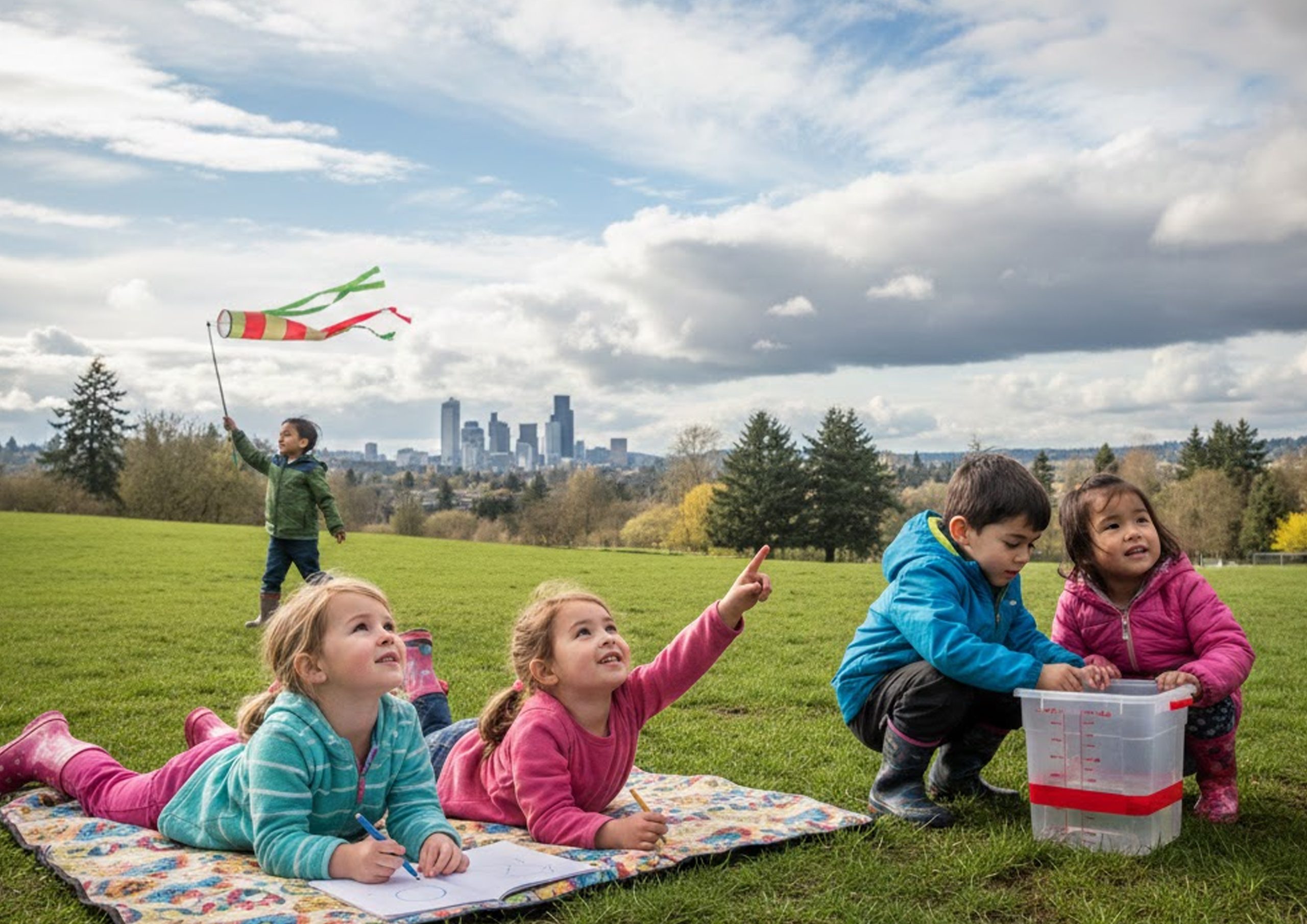
Living in the Pacific Northwest means children experience a wide range of weather — misty mornings, steady rain, dramatic cloud formations, and breezy afternoons. For preschoolers in Bellevue, North Seattle, Kirkland, and nearby Eastside communities, weather isn’t just something we talk about — it’s something we explore.
At Lil’ People’s World, weather investigations are part of our hands-on STEM experiences within our research-based Creative Curriculum. By observing clouds, measuring rainfall, and tracking wind, children build early science skills while connecting to their local environment.
Why Weather Studies Matter in Preschool
Weather learning introduces important early science concepts in ways young children can understand. Through observation and experimentation, preschoolers learn to:
- Notice patterns and changes
- Ask questions and make predictions
- Record observations
- Build descriptive vocabulary
- Understand cause and effect
In Washington State, kindergarten readiness includes curiosity, communication skills, and the ability to describe the world around them. Weather exploration supports all of these.
Exploring Clouds in Bellevue
The PNW sky offers endless opportunities to observe cloud types and changing conditions.
Simple cloud investigations include:
- Lying on a blanket and describing cloud shapes
- Noticing color changes before rain
- Comparing sunny, cloudy, and overcast days
- Drawing pictures of the sky
Teachers encourage children to use descriptive language such as fluffy, gray, thin, heavy, bright, and stormy. These vocabulary-building moments strengthen both science understanding and early literacy skills.
You can also introduce basic cloud categories in simple terms:
- Puffy clouds
- Thin, wispy clouds
- Dark rain clouds
Keep it age-appropriate and focus on observation rather than memorization.
Measuring Rainfall with a Simple Rain Gauge
Rain is part of everyday life in the Pacific Northwest. Measuring it turns a rainy day into a learning opportunity.
To make a simple rain gauge at home:
- Use a clear plastic container
- Mark measurement lines with tape and a marker
- Place it outside in an open area
- Check and record the water level daily
Ask your child:
- Did it rain more today or yesterday?
- How can you tell?
- What do you predict for tomorrow?
This builds early math skills like comparing amounts and understanding measurement.
Wind Exploration with a Windsock
Wind is invisible — but children can see its effects. Creating a simple windsock helps preschoolers understand movement and direction.
To make one:
- Use construction paper or a lightweight plastic cup
- Attach streamers or ribbons
- Hang it outdoors where wind can catch it
Observe together:
- Is the wind strong or gentle?
- Which direction are the streamers pointing?
- Does wind change throughout the day?
These discussions support spatial awareness and scientific thinking.
Skills Children Build Through Weather Learning
Weather investigations support whole-child development by strengthening:
- Observation and inquiry skills
- Early math concepts (measuring, comparing, tracking)
- Vocabulary and communication
- Patience and attention to detail
- Collaboration in group discussions
For families searching for the best preschool in Bellevue or a trusted early learning center in North Seattle or Kirkland, hands-on science exploration is a strong indicator of quality programming.
Connecting Weather to Kindergarten Readiness
Kindergarten teachers value children who can:
- Describe observations clearly
- Ask thoughtful questions
- Follow simple experiments
- Record basic information
- Work cooperatively
Weather learning naturally builds these abilities while keeping children engaged and curious.
Frequently Asked Questions
Is weather study too advanced for preschoolers?
Not at all. Preschool weather studies focus on observation and simple comparisons, not complex meteorology.
How often should we explore weather at home?
Even five minutes a day observing the sky or checking a rain gauge can build meaningful learning habits.
What if my child isn’t interested?
Follow their lead. Some children are fascinated by wind, others by puddles or clouds. Keep it playful and pressure-free.
Why Families Choose Lil’ People’s World
Families across Bellevue, North Seattle, Kirkland, and nearby Eastside communities choose us because we provide:
- Family-owned care since 1993
- Licensed, safe, and nurturing environments
- Low teacher-to-child ratios
- Research-based Creative Curriculum
- Consistent communication with families
- Programs from infant care through pre-K and before and after school care
Our classrooms encourage exploration of the natural world — rain boots included.
Discover Hands-On Early Learning in the PNW
In the Pacific Northwest, the weather is always changing — and that makes it the perfect science classroom. Through cloud watching, rainfall measuring, and wind tracking, children develop curiosity and confidence that prepare them for kindergarten and beyond.


