
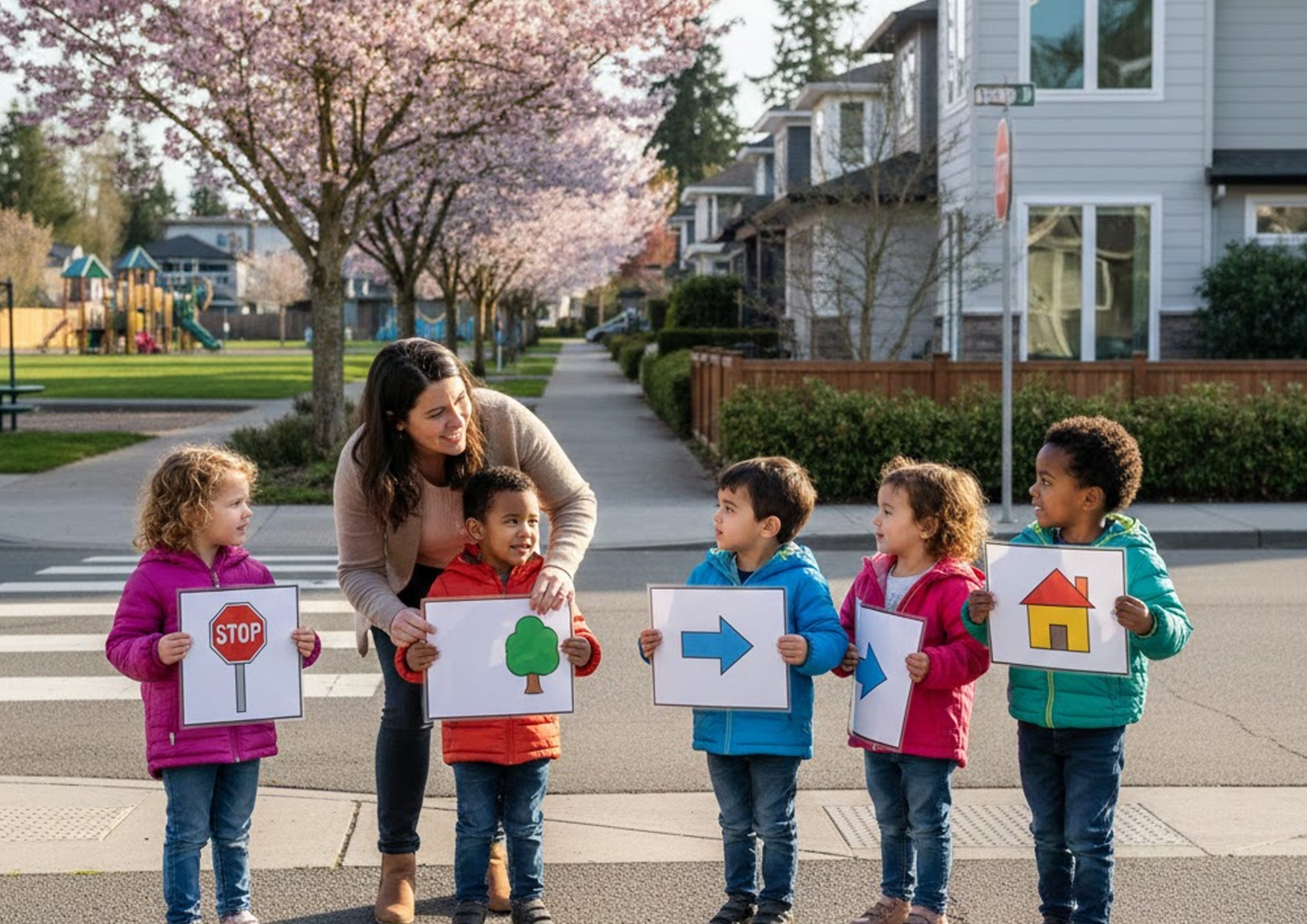
Did you know that simple neighborhood walks can build powerful early learning skills? In our Bellevue pre-K classrooms, children explore basic map skills through hands-on experiences like neighborhood walks and route cards — building spatial awareness, problem-solving, and kindergarten readiness along the way.
At Lil’ People’s World, serving families in North Seattle, Bellevue, Kirkland, and nearby Eastside communities, we integrate geography and spatial learning into our research-based Creative Curriculum. These activities strengthen both academic and real-world skills in meaningful, age-appropriate ways.
Why Map Skills Matter in Pre-K
Map skills may sound advanced, but the foundation begins in early childhood. Preschool and pre-K children are developing:
- Spatial awareness
- Directional language
- Memory and sequencing
- Observation skills
- Understanding of symbols
When children learn to follow simple routes and recognize landmarks, they are building critical thinking skills that support math, reading, and executive functioning.
What Are Early Map Skills?
In pre-K, map skills focus on simple concepts such as:
- Understanding that maps represent real places
- Recognizing symbols and pictures
- Using directional words (left, right, forward, behind)
- Following a simple path
- Identifying familiar landmarks
These foundational experiences prepare children for more advanced geography and problem-solving in elementary school.
Neighborhood Walks: Learning Beyond the Classroom
Neighborhood walks around our Bellevue locations provide authentic learning opportunities. During walks, children may:
- Identify stop signs, crosswalks, and traffic lights
- Notice buildings, parks, and natural features
- Observe street names
- Compare routes (shorter vs. longer paths)
Teachers encourage children to:
- Predict where the path leads
- Recall what they saw on a previous walk
- Describe landmarks
- Discuss safety rules
These real-world experiences build memory, language, and awareness of community spaces.
Route Cards: A Playful Way to Practice Directions
Route cards are simple visual guides that show a path using arrows, symbols, or pictures.
In the classroom, children may:
- Follow arrow cards to move through an obstacle course
- Use picture maps to navigate centers
- Match symbols to classroom areas
- Create their own simple route drawings
This playful practice strengthens:
- Directional understanding
- Sequencing skills
- Fine motor development
- Problem-solving
Route cards also support executive functioning by helping children follow multi-step instructions.
How Map Skills Support Kindergarten Readiness
Kindergarten teachers value children who can:
- Follow directions
- Use positional words correctly
- Recall and describe events
- Recognize symbols
- Demonstrate independence in navigating spaces
Map skill development naturally supports these abilities while fostering confidence and curiosity.
Bringing Map Learning Home
Families in Bellevue and the surrounding Eastside communities can support map skills by:
- Drawing simple maps of your home
- Creating a treasure hunt with directional clues
- Talking about landmarks on your way to school
- Asking, “Which way should we turn?”
- Letting your child help plan a short walking route
Keep it playful and interactive.
Frequently Asked Questions
Is map learning too advanced for pre-K?
No. At this age, map skills are simple, visual, and experiential — not formal geography lessons.
What if my child mixes up left and right?
That’s completely normal. Directional understanding develops gradually with practice.
How often should children practice these skills?
Even short weekly walks or simple route games can make a meaningful impact.
Why Families Choose Lil’ People’s World
Families across Bellevue, North Seattle, Kirkland, and nearby Eastside communities choose us because we provide:
- Family-owned care since 1993
- Licensed and insured facilities
- Low teacher-to-child ratios
- Research-based Creative Curriculum
- Safe, clean learning environments
- Programs from infant care through pre-K and before and after school care
- Strong communication and family partnerships
Our pre-K classrooms blend academic preparation with real-world exploration.
Exploring the World, One Step at a Time
Through neighborhood walks and route cards, children learn that maps tell stories about the world around them. These simple experiences build spatial awareness, independence, and confidence — key ingredients for kindergarten success.
If you’re exploring pre-K programs in Bellevue or the surrounding Eastside communities, we’d love to show you how we make learning active, meaningful, and joyful.


