
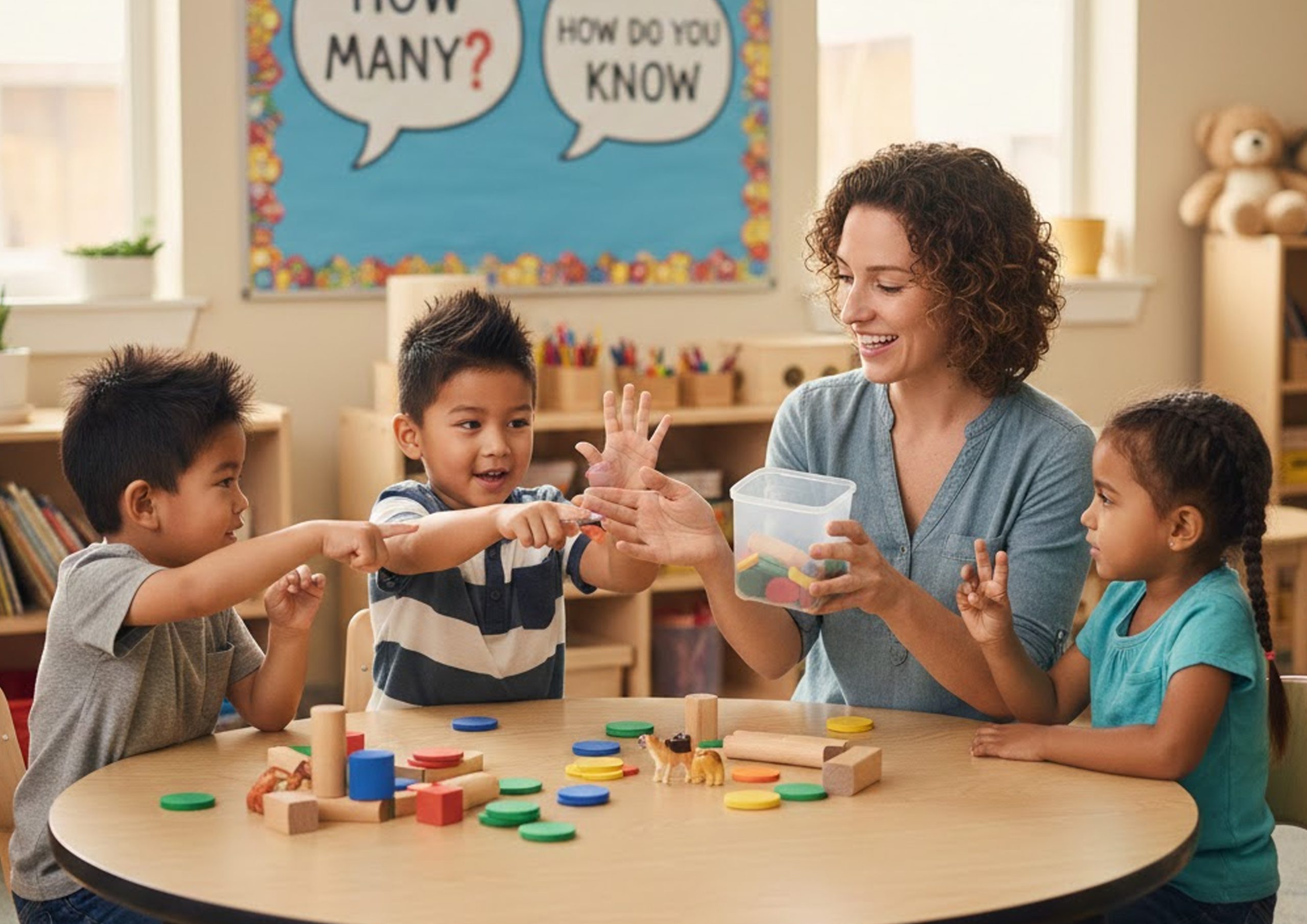
When families think about preschool, they often picture storytime, art projects, and playtime. However, early math conversations are just as important for kindergarten readiness. In fact, simple questions like “How many?” and “How do you know?” can spark powerful thinking in young learners.
At Lil’ People’s World, serving Bellevue, North Seattle, Kirkland, and nearby Eastside communities, math talks are a regular part of our preschool and pre-K classrooms. Through intentional conversations guided by our research-based Creative Curriculum, children build number sense, reasoning skills, and confidence in problem-solving.
What Is a Math Talk?
A math talk is a short, structured discussion where children explore a math concept together. Rather than memorizing answers, students explain their thinking.
For example, a teacher might show a small group of counters and ask:
- “How many do you see?”
- “How did you figure that out?”
- “Did anyone solve it a different way?”
Because children are encouraged to explain their reasoning, they develop deeper understanding instead of relying on rote counting alone.
Why “How Many?” Matters
At first glance, asking “How many?” may seem simple. Yet, this question builds foundational number sense.
When children answer, they may:
- Count one by one
- Recognize a familiar pattern
- Subitize (instantly recognize small quantities)
- Group items into sets
Consequently, preschoolers begin seeing numbers as relationships rather than isolated digits.
The Power of “How Do You Know?”
While “How many?” focuses on quantity, “How do you know?” encourages reasoning. This follow-up question invites children to describe their thinking process.
For instance, a child might say:
- “I saw two groups of three.”
- “I counted by twos.”
- “I knew it was five because it looks like a dice.”
As a result, math becomes a language-rich experience. Children learn that there can be multiple ways to solve the same problem.
Building Confidence Through Discussion
Math talks are intentionally low-pressure. There is no single “fastest” or “best” answer. Instead, teachers celebrate effort and thoughtful explanations.
Because we maintain low teacher-to-child ratios in our Bellevue preschool classrooms, educators can guide each child’s participation. Additionally, they model respectful listening and encourage peers to consider different strategies.
Over time, children gain confidence in sharing ideas — an essential skill for kindergarten.
Integrating Math Talks into Daily Routines
Math discussions are woven naturally into everyday classroom experiences.
For example:
- Counting classmates during attendance
- Comparing snack portions
- Measuring block towers
- Sorting materials by size or shape
Rather than isolating math to a worksheet, teachers embed it throughout the day. Therefore, children begin recognizing that math is part of real life.
Supporting Executive Function Skills
Beyond number recognition, math talks strengthen executive functioning skills such as:
- Listening carefully
- Waiting for a turn to speak
- Organizing thoughts
- Explaining reasoning
- Evaluating different solutions
These cognitive abilities directly support kindergarten readiness and long-term academic success.
Extending Math Conversations at Home
Families in Bellevue and nearby Eastside communities can reinforce math thinking with simple prompts:
- “How many apples are on your plate?”
- “How do you know there are more cars on this side?”
- “Can you show me a different way to count?”
Even during grocery shopping or neighborhood walks, these small conversations build big skills.
Why Early Math Conversations Matter
Children who regularly engage in math discussions develop stronger number sense, flexible thinking, and problem-solving abilities. Moreover, they learn that mistakes are part of learning — not something to fear.
By encouraging children to explain their thinking, we help them become confident learners who approach challenges with curiosity.
Choosing a Preschool in Bellevue That Prioritizes Early Math
Families searching for the best preschool in Bellevue often look for programs that prepare children academically while maintaining a nurturing environment.
Since 1993, Lil’ People’s World has been a family-owned early learning center dedicated to whole-child development. Our licensed and insured programs provide infant care, toddler programs, preschool, pre-K, and before and after school care across Bellevue, North Seattle, Kirkland, and nearby Eastside communities.
Through experienced educators, low teacher-to-child ratios, and a research-based curriculum, we create safe, clean, and engaging classrooms where young mathematicians thrive.
If you’re exploring preschool options in Bellevue and want to see how math talks support early learning, we invite you to schedule a tour.


